
Why You Need To Know About Ring Theory
Susan Silk's psychological theory that helps keep you from being a jerk.

Have you ever tried to support someone in crisis and, instead, said the wrong thing?
I’m sure you have. And if you think you haven’t, you have and you don’t know it. I’m sorry to break it to you.
When I first read about Ring Theory, I realized that it was the key to explaining why I’d felt like I had fumbled when talking to the occasional divorcing friend or co-worker whose dad had cancer. And even more so, I recognized the times that I had been the one in crisis, or whose mom had cancer, or whose child had a terrible accident, and people had said things to me that made me feel worse instead of better.
Clinical psychologist Susan Silk developed the concept of the Ring Theory when she suffered from breast cancer, and some colleagues said some truly “lame” (her words) things to her. Susan and her husband, Barry Goldman, describe an exchange that helped inspire their theory in a LA Times article they wrote back in 2013.
[A colleague] wanted, she needed, to visit Susan after the surgery, but Susan didn’t feel like having visitors, and she said so. Her colleague’s response? “This isn’t just about you.”
“It’s not?” Susan wondered. “My breast cancer is not about me? It’s about you?”
Many times, we encounter situations, like a friend’s disease or accident, that inspire big feelings in us. But when we want to support that friend, or that friend’s spouse or children, we can’t do it by bringing our feelings of hurt or sadness into the conversation. It doesn’t work.
The Ring Theory is actually quite simple. Imagine a series of rings. The person in crisis is at the center of the rings. Each larger ring includes people who are increasingly removed from the person in crisis. So, for example, a woman with cancer would be in the center, the first ring might include only her husband, the next her children and parents, the next close friends and extended family, and so on.
Now, here’s the important part.
The person in the center ring can “dump” their feelings out to anyone in any ring. As Silks and Goldman say:
[That person] can kvetch and complain and whine and moan and curse the heavens and say, “Life is unfair” and “Why me?” That’s the one payoff for being in the center ring.
Everyone else can discuss their complaints and feelings too, but here’s the important point: they can only dump out to people in larger rings. For the person in crisis and those in any smaller rings, those in the larger rings should only offer support and comfort.
Dump out.
Support in.
Like this:
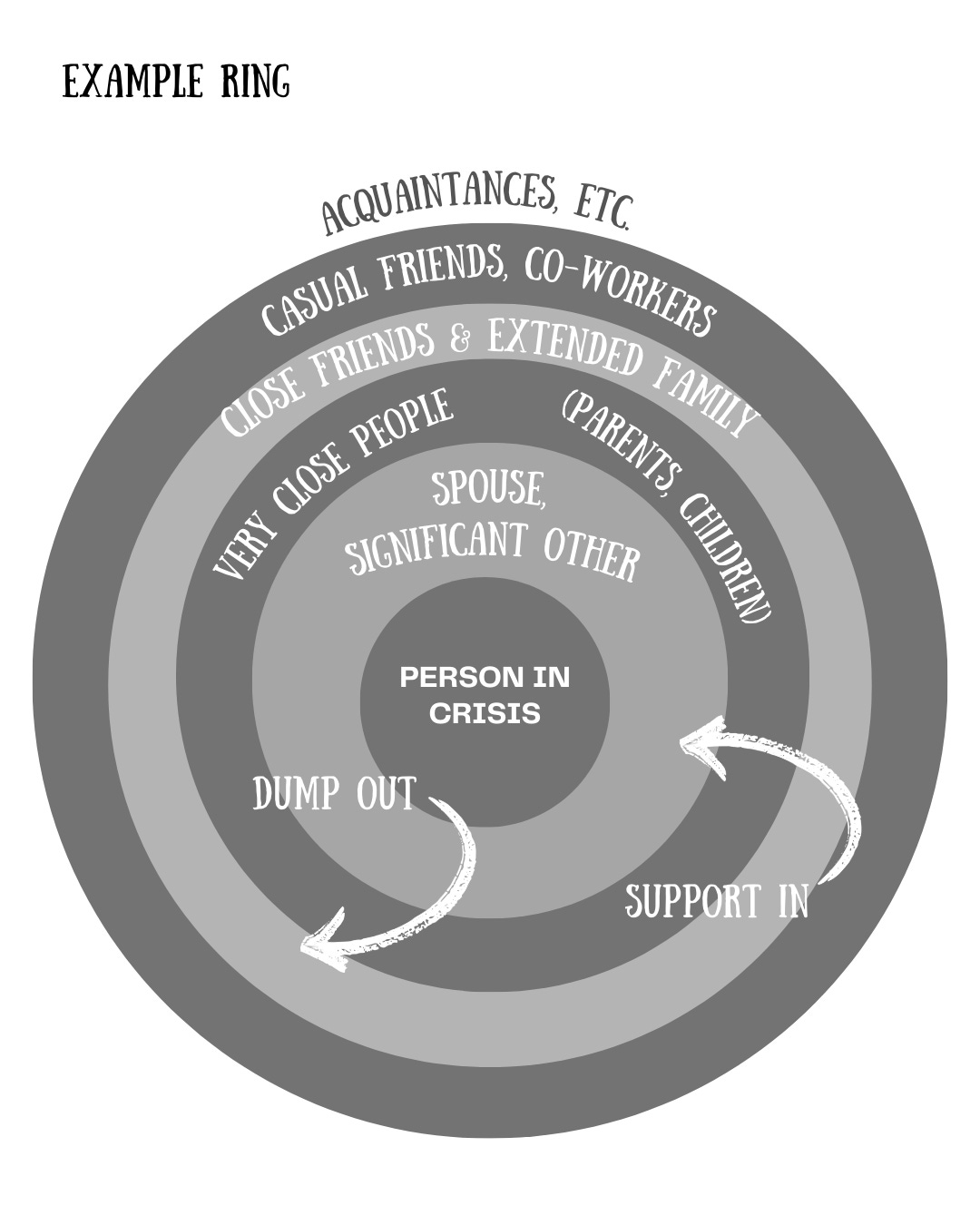
When you dump your feelings in to someone closer to the person in crisis, you increase the suffering of those people. I’m assuming that’s not what you’re going for. You want to provide them with the support and comfort they need to get through their crisis.
What would you like me to get you for dinner?
I’m sorry this is happening to you.
I love you!
But Silk and Goldman point out that listening is likely to be the most significant way to provide support and comfort. It can be hard to find the right thing to say to someone in crisis, but it’s not hard to find the right way to listen.
News
I have been busy recovering from vocal cord surgery. The procedure really kicked my migraine activity into high gear, so I have been struggling a bit. I’m grateful that I had an appointment already scheduled for trigger point shots (my main treatment method for migraines and other head and scalp pain). I hope I’ll be improving soon.
My voice is getting better, too! It’s not a linear improvement, and of course, it scares me anytime it gets the least bit raspy. I’ve learned that I cannot limit myself well in social environments, although I’m doing pretty well at remembering to stand close to people rather than talk across the room, avoiding raising my voice, and drinking lots of water. So I am instead limiting myself to very few outings or visits so that I don’t overdo.
I’ve also got muscle tension dysphonia, so my larynx feels uncomfortable and achy most of the time, and sometimes tension stops me from speaking mid-conversation. I’m hopeful that vocal therapy, which starts next week, will get me in a fully functional, non-painful place.
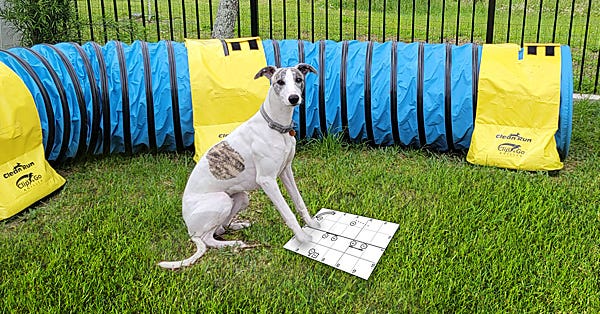
In work-related news, my Backyard Training Matters Weekly Training Group (a 6-week course) is now up for sale! I usually have quite a few repeat students because we have a lot of fun, and they get tons of practice and training time. If you are a dog agility person, please check it out and/or share it with your friends!
Shop with Me
We are doing as little shopping as possible right now because have you seen how much groceries cost? SO MUCH! But here are a few of my favorite things:
Pantene Miracle Rescue 3 in 1 Leave-In Conditioner, Rinse off Conditioner. It’s a conditioner and a styling product for my curls. Look, I’m no fancypants influencer person, I’m just about doing the bare minimum that works. It’s on sale, too.
These tiny, crunchy, dog training treats are inexpensive, low-calorie, and reasonably healthy.
This super cute cat pillow is a favorite in my daughter’s dorm room.
This six-book serial is a fun read! It’s free in Kindle Unlimited and inexpensive in e-book form. It’s perfect for spooky season (and it’s not really spooky).
Want to support this newsletter?
Thanks! See you next week!
(As an Amazon Associate, I may earn from purchases made through the links above.)